Every year, hundreds of thousands of first-time visitors to India face the same question: where do I even begin? The country is vast, layered, and overwhelming in the best possible way. And for most people, the answer to that question has been the same for decades — start with the Golden Triangle.
This is not just a tour route. It’s India’s greatest hits compressed into one logistically manageable, historically rich, and culturally diverse journey. In ten days or fewer, you move from the chaotic energy of a living, breathing capital city to the quiet grandeur of the world’s most recognizable monument of love, and finally into the sun-bleached splendor of a former Rajput kingdom where palaces still glow pink at dawn. If you have been wondering what the Golden Triangle Tour India actually is — and whether it’s right for you — this guide gives you the full picture.
What is the Golden Triangle Tour India?
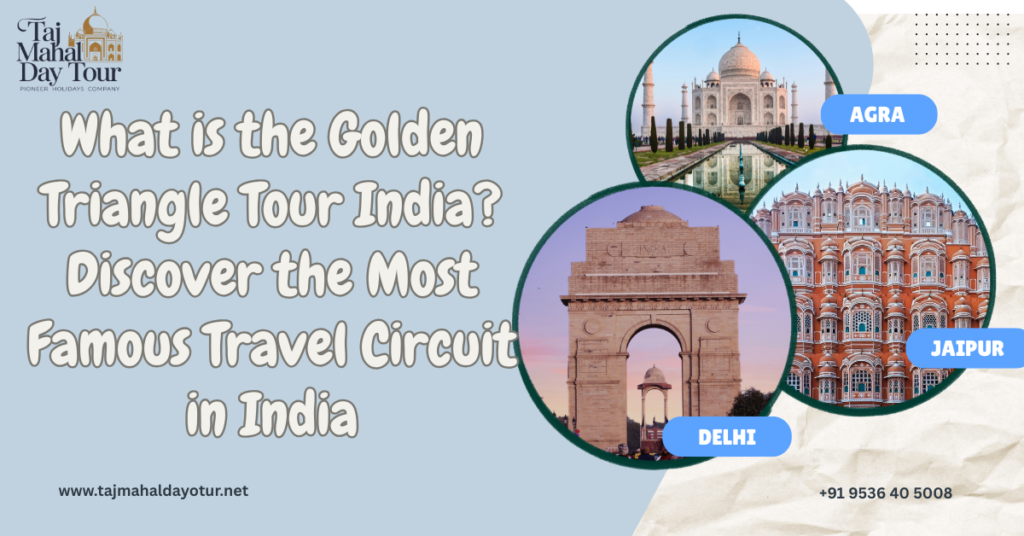
The Golden Triangle is a travel circuit connecting three of North India’s most historically significant cities: Delhi, Agra, and Jaipur. When you draw lines between these three cities on a map, they form a rough triangle — and that simple geographic shape is where the name comes from.
Delhi sits at the northern point of the triangle, Agra lies roughly 200 kilometers to the southeast, and Jaipur is positioned about 260 kilometers to the southwest of Delhi. The distances are manageable by road or train, which is partly why this circuit became so popular with international tourists. You are not crossing half a continent to move between cities — each leg of the journey takes three to five hours at most, leaving you with energy to actually explore when you arrive.
The phrase “Golden Triangle” is partly a marketing term that stuck, but it also carries a more poetic resonance. These three cities represent three golden chapters of Indian history: the Mughal Empire at its architectural zenith in Agra, the layered Islamic-Hindu-British palimpsest of Delhi, and the royal Rajput legacy of Jaipur. Together, they offer a concentrated introduction to the complexity and grandeur of Indian civilization.
The Three Cities: What Each One Offers
Delhi — Layered, Loud, and Endlessly Surprising
Most tours begin in Delhi, and that makes sense both logistically and narratively. The capital is India’s entry point for most international visitors, and it’s also a city where you can read centuries of conquest, commerce, and reinvention in a single afternoon walk.
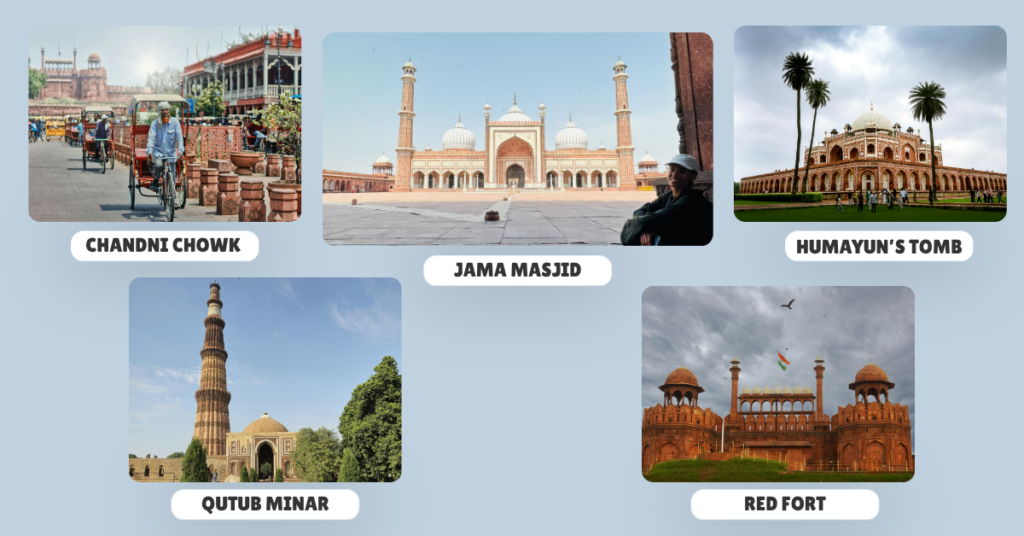
Old Delhi is the quarter that stops people in their tracks. The lanes around Chandni Chowk have been selling spices, fabrics, street food, and silver since the 17th century. Jama Masjid, one of South Asia’s largest mosques, rises above the rooftops with a quiet authority that cuts through the noise. A cycle rickshaw ride through the old city’s narrow galis — alleyways barely wide enough for two people — is the kind of experience that stays with you.
New Delhi, designed by Edwin Lutyens in the early 20th century during British colonial rule, tells a very different story. Wide, tree-lined boulevards, sandstone government buildings, and India Gate offer a sharp contrast to the medieval density just a few kilometers away. Humayun’s Tomb, often overlooked in favor of the Taj Mahal, is one of the finest examples of Mughal garden tomb architecture in existence and deserves more time than most visitors give it. Qutub Minar, the 73-meter victory tower built in the 12th century, is extraordinary up close.
Food in Delhi is a genuine reason to linger. Paranthe Wali Gali in Old Delhi serves fried flatbreads stuffed with everything from spiced potatoes to dry fruits. Khan Market and Connaught Place offer more contemporary dining, but the city’s soul is in its street food — chaat, chole bhature, kebabs from narrow smoke-filled stalls along Jama Masjid’s outer walls. Plan at least two full days here.
Agra — Where the Mughal Empire Left Its Greatest Mark
People come to Agra for the Taj Mahal, but they often leave with a deeper appreciation for what the Mughal Empire actually was: a civilization that commissioned architecture with a precision and aesthetic ambition rarely matched in human history.
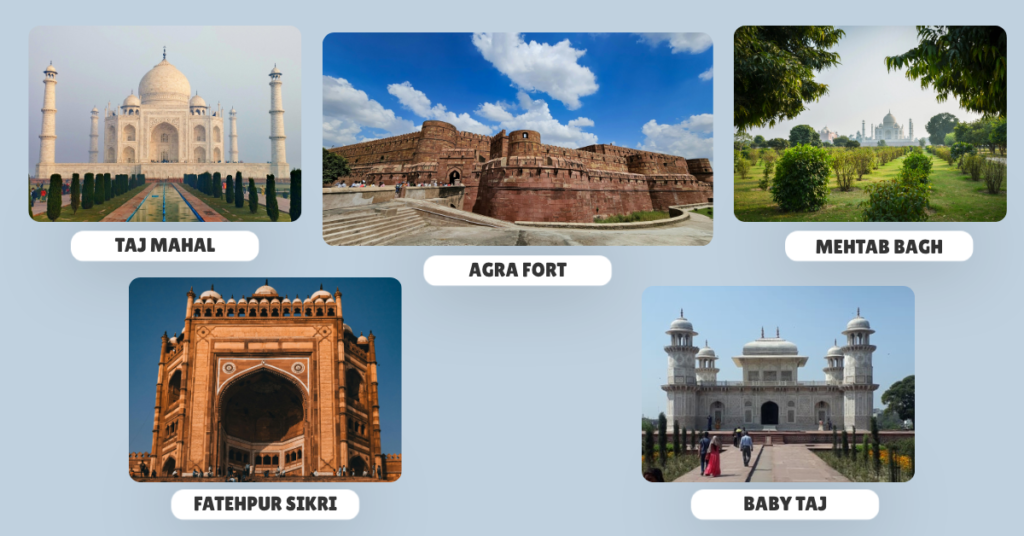
The Taj Mahal is one of those rare landmarks that exceeds its reputation. It is genuinely as extraordinary in person as the photographs suggest — and then some. The symmetry is perfect. The white marble shifts color with the light, turning faintly gold at dawn, a cool blue at dusk, and almost luminous under a full moon. Emperor Shah Jahan commissioned it in 1632 as a mausoleum for his wife Mumtaz Mahal, and it took 22 years and over 20,000 artisans to complete. Arriving early in the morning, before the crowds fully form, is one of travel’s most genuinely moving experiences.
But don’t stop at the Taj. Agra Fort — a massive red sandstone complex less than three kilometers away — held emperors, prisoners, and courts of governance for over a century. Inside its walls are marble palaces, audience halls, and terraces with clear views of the Taj Mahal across the Yamuna River. The relationship between these two monuments, seen together, tells the full arc of Shah Jahan’s life and legacy.
Fatehpur Sikri, 40 kilometers outside Agra, is the abandoned Mughal capital built by Emperor Akbar in the 1570s. It was occupied for only 14 years before being deserted, likely due to water shortages. Walking through its sandstone courtyards, which remain in remarkable condition, feels like stepping into a city caught mid-sentence. One full day in Agra is possible; two is better.
Jaipur — The Pink City and the Rajput Spirit
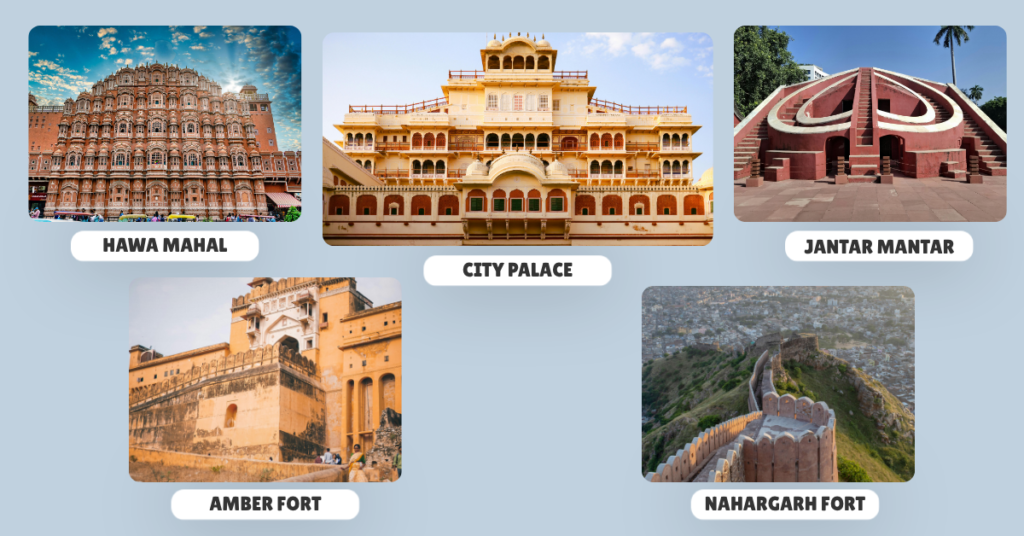
After the Mughal grandeur of Agra, Jaipur introduces you to an entirely different chapter of Indian history — the Rajput kingdoms of Rajasthan, with their warrior culture, elaborate court traditions, and a flair for architecture that leaned into spectacle with evident pleasure.
The city is famous for its distinctive terracotta-pink buildings, a color applied to most of the old city’s facades in 1876 to welcome the Prince of Wales. The effect is extraordinary, especially in the golden hour before sunset, when the entire city takes on an amber warmth that no camera fully captures.
Amber Fort — the name is sometimes spelled Amer — stands on a ridge above the city and is one of the most complete and visually dramatic forts in Rajasthan. The interior’s Sheesh Mahal, a hall lined with thousands of tiny mirror tiles, reflects a single candle flame into thousands of points of light. The elephant rides up the fort’s cobbled ramp have become controversial from an animal welfare perspective; a jeep or on-foot ascent is the better choice today.
The City Palace remains a working royal residence, with portions open to visitors. The Hawa Mahal, the five-story “Palace of Winds” with its honeycomb screen of 953 small windows, was built so royal women could observe street life while remaining unseen — its facade is one of the most photographed in India, with good reason. Jantar Mantar, the open-air astronomical observatory built by Maharaja Jai Singh II in the 18th century, contains instruments of extraordinary size and precision, including a sundial that can measure time accurate to two seconds.
Jaipur’s bazaars are worth significant time. Johari Bazaar is the place for gemstones and silver jewelry. Bapu Bazaar sells traditional Rajasthani textiles, block-printed cottons, and leather jutis — the pointed-toe shoes associated with the region. The food is rich and distinct: dal baati churma (lentils, baked wheat dumplings, and sweet crumbled wheat), laal maas (a fiery red meat curry), and an abundance of milk-based sweets. Plan two full days here, or extend to three if you want to cover the surrounding areas.
City Comparison: At a Glance
| City | Famous Attractions | Best Experience | Ideal Stay |
|---|---|---|---|
| Delhi | Qutub Minar, Humayun’s Tomb, Red Fort, Chandni Chowk, India Gate, Jama Masjid | Cycle rickshaw through Old Delhi’s spice markets at dusk | 2 nights |
| Agra | Taj Mahal, Agra Fort, Fatehpur Sikri, Mehtab Bagh | Sunrise at the Taj Mahal before the crowds arrive | 1–2 nights |
| Jaipur | Amber Fort, City Palace, Hawa Mahal, Jantar Mantar, Nahargarh Fort | Exploring gemstone bazaars and watching sunset from Nahargarh | 2 nights |
Why is the Golden Triangle Tour So Popular?
Several factors have made this the default introduction to India for international travelers — and most of them are practical as well as experiential.
- Logical route design: The cities are close enough to move between comfortably, but different enough to feel like distinct worlds. You’re never doubling back or crossing long, exhausting distances.
- Historical range: Within a single trip, you move through Sultanate-era architecture, Mughal imperial zenith, British colonial planning, and Rajput royal heritage. Few travel routes anywhere in the world cover this much historical ground so efficiently.
- Strong tourism infrastructure: Hotels, guides, transportation, and airport connections in all three cities are well-developed. For first-time visitors to India who are still calibrating their comfort level, this predictability is genuinely valuable.
- Food diversity: Mughal-influenced kebabs and biryanis, Rajasthani dal baati, Delhi street food — the three cities each have distinct regional cuisines, so the eating experience never repeats itself.
- Photography opportunities: The Taj Mahal alone attracts photographers from around the world. But the light falling through Amber Fort’s lattice windows, the pink facades of Jaipur at golden hour, the medieval skyline of Old Delhi — the entire route is visually extraordinary.
- Suitable for different travel styles: Whether you are traveling solo on a mid-range budget, with family, as a couple on a luxury honeymoon, or on a group tour, the Golden Triangle accommodates it all. Accommodation options range from heritage havelis to international five-star chains.
Best Time to Visit the Golden Triangle
October – March
Peak season. Cool, dry weather with temperatures between 8°C and 25°C. Best visibility at the Taj Mahal. Ideal for sightseeing. Book early — accommodation fills up fast.
April – June
Pre-monsoon heat. Temperatures regularly exceed 40°C in Agra and Jaipur. Manageable with early starts and afternoon breaks. Fewer tourists, lower prices.
July – September
Monsoon season. Rain brings cooler temperatures and green landscapes. Humidity can be high. Some days are fully clear. Not ideal for most visitors, but atmospheric.
For most international travelers, November through February is the sweet spot. The light in winter mornings is exceptional, the air is clear, and the temperature never becomes a problem. Diwali (typically October–November) transforms Jaipur and Delhi into extraordinary celebrations of light, and Holi (February–March) in Jaipur is one of the most exuberant festivals in India.
Suggested Golden Triangle Itineraries
One of the advantages of this route is its flexibility. You can compress it into a long weekend or stretch it across two weeks depending on your schedule and interests.
A 3-day Golden Triangle tour is the bare minimum — it covers each city in a single focused day and is really suited to those with very tight schedules. You’ll tick the major monuments, but there’s no time for wandering.
The 4-day version gives you one proper day each in Agra and Delhi, with a more relaxed morning in Jaipur. This is the most commonly booked format among independent travelers, and it strikes a reasonable balance. The 5-day itinerary adds a meaningful buffer — time for Fatehpur Sikri, Mehtab Bagh (the garden across the river from the Taj Mahal, which gives a remarkable alternate view), and a proper Jaipur morning in the bazaars.
For those who want depth over speed, the 6-day tour allows you to breathe, get a little lost, and actually absorb what you’re seeing rather than rushing between monuments. Adding a wildlife dimension, the 7-day tour including Ranthambore National Park is particularly compelling — Ranthambore is one of India’s best tiger reserves, and combining a tiger safari with the cultural circuit creates a genuinely memorable trip.
Extending into Varanasi — perhaps the most spiritually intense city in India — the 8-day Delhi–Agra–Jaipur–Varanasi tour transforms the Golden Triangle into something more ambitious and deeply rewarding. And for those with two full weeks, the 13-day extended Rajasthan tour sweeps through Jaisalmer’s desert fort, Jodhpur’s Blue City, and the lake palaces of Udaipur — one of the most complete India itineraries available.
Travel Tips for First-Time Visitors
- Clothing: Pack light, breathable fabrics in modest cuts. Shoulders and knees should be covered when entering temples, mosques, and forts — carry a scarf or light layer for these moments. Comfortable, closed-toe shoes matter more than you expect once you’re walking cobblestoned fort interiors.
- Transport: Pre-booked private cars with drivers are the most comfortable and efficient way to move between and within cities. The Gatimaan Express train between Delhi and Agra is fast and reliable for that particular leg. Negotiate auto-rickshaw rates before boarding, or use metered/app-based options in Delhi and Jaipur.
- Local etiquette: Remove shoes before entering places of worship. Ask permission before photographing people, particularly in rural or traditional contexts. Accept chai if offered — refusing is occasionally taken as a mild slight. Bargaining is expected in markets but keep it good-humored.
- Safety: The Golden Triangle is one of India’s most visited and policed tourist corridors. Exercise the same general urban awareness you would anywhere: keep valuables secure, be cautious about unsolicited offers of “special” tours or shops, and trust your instincts in unfamiliar situations.
- Currency: India operates largely on cash in traditional markets. ATMs are widely available in all three cities. Carry smaller denominations — change can be scarce for large notes in local shops and rickshaws.
- Photography: The Taj Mahal prohibits tripods inside the main complex. Many forts charge a separate camera fee. Early morning and the last hour of daylight give the best light for monument photography. For street photography, a shorter prime lens is less intrusive than a large zoom.
- Guides: A knowledgeable local guide at the Taj Mahal, Agra Fort, and Amber Fort meaningfully deepens the experience. Architecture without context is just ornament — a good guide transforms what you’re seeing into history you can feel.
Food Recommendations
Don’t miss: chaat at Chandni Chowk (Delhi), kebabs at any stall near Jama Masjid, petha (a translucent sweet made from ash gourd) as a souvenir from Agra, and dal baati churma in Jaipur. Carry a bottle of water at all times — hydration in the heat is non-negotiable.
Frequently Asked Questions
How many days do you need for the Golden Triangle Tour India?
A minimum of 5–6 days gives you a genuine experience of all three cities without feeling rushed. Three days is physically possible but leaves little room for wandering or unexpected discoveries, which are often the best parts of any trip. If you can manage 7–8 days, the extra time to add Ranthambore or Varanasi is well worth it.
Is the Golden Triangle Tour safe for solo female travelers?
Yes, with sensible precautions. The major tourist sites are well-staffed and patrolled. Many solo female travelers complete this circuit annually without serious incident. Staying in reputable hotels, using pre-booked transport rather than flagging down random taxis late at night, dressing modestly, and being firm but polite when declining unwanted attention are the practical measures that matter most. Traveling with a reputable tour operator provides an additional layer of comfort and logistical support.
Is the Golden Triangle suitable for families with children?
Absolutely. The circuit is one of the more family-friendly options in India precisely because the cities are close, the infrastructure is solid, and the sights genuinely fascinate children. The Taj Mahal, elephant encounters near Amber Fort, Jaipur’s street markets, and Old Delhi’s sensory chaos all tend to make lasting impressions on younger travelers. The key is pacing — don’t try to fit more than two or three major sites into a single day with children in tow.
What is the best way to travel between Delhi, Agra, and Jaipur?
A private car with a driver is the most flexible and comfortable option, particularly if you’re traveling as a pair or family and want to stop at Fatehpur Sikri en route from Agra to Jaipur. The Gatimaan Express train (Delhi to Agra) is a fast and reliable alternative for that specific leg. Buses are inexpensive but significantly less comfortable for long-haul sections. Most organized Golden Triangle tour packages include private transport as standard, which makes the logistics much easier to manage.
Are luxury Golden Triangle tours available?
Yes, and North India is genuinely exceptional for luxury travel. The circuit has some of India’s finest heritage hotels — including the Oberoi Amarvilas in Agra, positioned with direct views of the Taj Mahal, the Taj Rambagh Palace in Jaipur (a former royal residence), and the Leela Palace in Delhi. Private tours with expert cultural guides, exclusive after-hours access to some monuments, and custom culinary experiences can be arranged through specialist operators. The Golden Triangle tour packages available range from standard to fully customized luxury.
Can the Golden Triangle be extended to include other destinations?
Very easily, and many travelers do. Ranthambore National Park (for tiger safaris) is a natural add-on between Agra and Jaipur. Varanasi, India’s oldest living city and the spiritual heart of Hinduism, pairs well as a post-Agra detour. Pushkar, about 150 kilometers from Jaipur, is a sacred lake town hosting one of India’s most extraordinary camel fairs in November. The circuit can also be extended deeper into Rajasthan — Jodhpur, Jaisalmer, and Udaipur are all logical extensions for those with more time.
Do I need a visa to visit India for the Golden Triangle Tour?
Most nationalities require a visa to enter India. The e-Visa system — applied for online before travel — is straightforward and available to citizens of most countries. Processing typically takes 3–5 business days, though applying a week or more in advance is advisable. Check the official Indian government e-Visa portal for your specific nationality’s eligibility and requirements before booking flights.
Ready to Plan Your India Golden Triangle Tour?
The Golden Triangle is the kind of journey that recalibrates your sense of what travel can be. It’s not a checklist of monuments — it’s an immersion into a civilization that has been building, trading, celebrating, and arguing over ideas for millennia. Delhi’s chaotic genius, Agra’s quiet heartbreak, Jaipur’s unabashed theatricality — each city changes you a little, and the combination changes you a lot.
Whether you’re planning a compact 3-day sprint or a leisurely 13-day journey through all of Rajasthan, the key is having the right structure around you so that logistics don’t eat the experience. Taj Mahal Day Tour specializes in customized India Golden Triangle tours — from private day tours to fully tailored multi-week India travel itineraries built around your interests, budget, and pace. Explore their range of Golden Triangle travel packages, ask questions, and start planning a trip you’ll genuinely remember.
India rewards those who show up curious and open. The Golden Triangle is where most people start. For many, it’s the trip that makes them want to come back.
Our official Website – Pioneer Holidays